 Kush
Kush 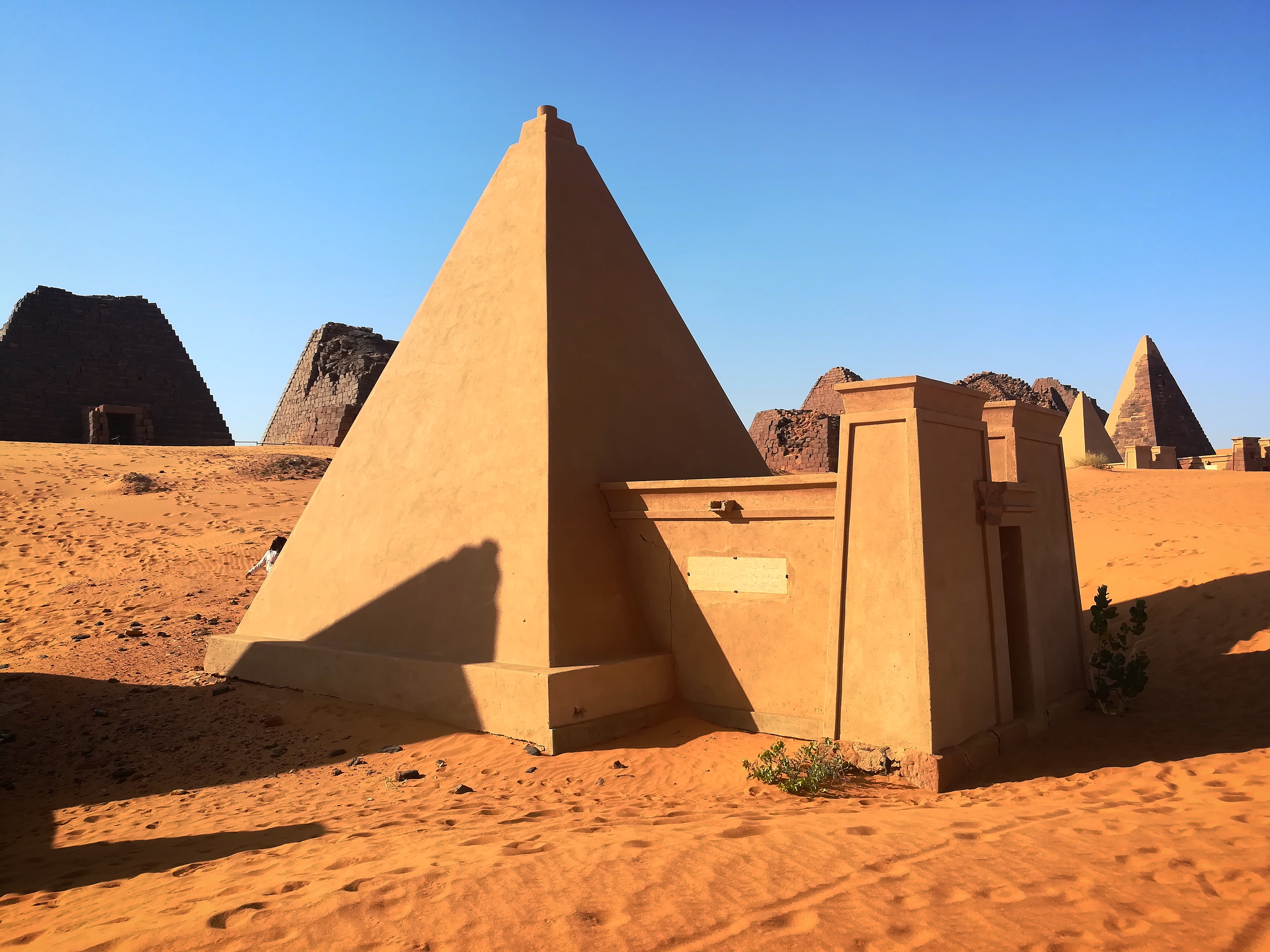
Photo: Ahmed Amir, CC BY-SA 4.0, via Wikimedia Commons
Nubian Pyramids vs. Egyptian Pyramids: What's the Difference?
Egypt and Kush both built pyramids, but the two do not look alike up close. Egypt’s are wide, gradual, and enormous. Kush’s are narrow, steep, and far more numerous.
Most people will never stand at the base of either one. Words and numbers can only close that gap so far, but real comparisons help with a shape that is hard to picture from a photo alone.
How Tall, Really
Egypt’s Great Pyramid at Giza originally reached about 146 meters. Most pyramids at Meroë stand between 6 and 30 meters.
Put another way: 146 meters is close to the height of a 45-story building. When it was finished, around 2560 BCE, it became the tallest structure on Earth. It held that record for almost 3,800 years, longer than any building has held it since or likely ever will again.
A typical pyramid at Meroë is closer to the height of a five-story apartment building. Some of the smallest are barely taller than a two-story house. A visitor could walk the length of an entire pyramid field at Meroë in less time than it takes to walk around the base of Giza’s alone.
The Angle Makes the Difference
The angle of the sides matters just as much as the height. It changes how each pyramid feels to stand next to.
About 146 meters tall
6 to 30 meters tall
At Giza, the sides rise at about 52 degrees. Stand close to the base and the peak still looks far away, rising up and out into the distance. At Meroë, the sides climb at closer to 70 degrees. Stand at the base of one of these and the top feels almost directly overhead. The steep angle is a large part of why people describe Kush’s pyramids as looking more like spikes than mountains.
Built With Less, Built More Often
The size difference shaped how each civilization was able to build over time.
Giza’s Great Pyramid used roughly 2.3 million blocks of limestone and granite, many weighing several tons each. For a long time, popular imagination pictured that labor as slave gangs working under the whip. Modern archaeology tells a different story. Excavations beside the pyramids uncovered a purpose-built workers’ town, complete with bakeries, breweries, and a cemetery for laborers buried with honors. The evidence points to a large, paid workforce of Egyptian citizens, rotated in shifts and honored in death for what they built.
Solid figures for the workforce behind any single Kushite pyramid have not survived. What is clear is the difference in scale. A pyramid one-fifth the height of Giza’s, built from far fewer and smaller blocks, simply required a fraction of the material and labor. That difference is a real part of why Kush could keep building pyramids for close to a thousand years, generation after generation, while Egypt’s era of pyramid building had already slowed by the time Kush’s began.
What’s Buried Inside Each One
Both civilizations kept the body separate from the pyramid’s solid mass, but not in the same way.
Giza’s Great Pyramid holds finished chambers built into its own body, reached by internal passages cut through the stone. Kush’s pyramids have no chambers inside them at all. The body rested in a separate chamber cut into the bedrock underground, and the pyramid above it was solid stone and rubble from base to tip, built purely as a solid marker, with no chambers a person could enter.
At a Glance
Height
Egypt, Giza
About 146 meters
Kush, Meroë
6 to 30 meters
Slope
Egypt, Giza
About 52 degrees
Kush, Meroë
About 70 degrees
Burial chamber
Egypt, Giza
Built inside the pyramid's body
Kush, Meroë
Underground, below the pyramid
Who received one
Egypt, Giza
Mostly pharaohs, over a narrower span of time
Kush, Meroë
Kings, Kandakes, and nobles, over close to a thousand years
Curious what daily life actually looked like at each of those levels? Rich vs. Poor in Ancient Kush breaks down the social hierarchy in full, from king and Kandake down to farmers and laborers.
One Idea, Two Kingdoms
Kush’s rulers spent time in Egypt, saw Egypt’s pyramids, and carried the idea home on purpose. What they built with it was their own.
Curious about the deeper connection between these two peoples? They intermarried and traded across this same river for thousands of years. Read what Nubian or Kushite ancestry actually means for a plain explanation of what that history can and cannot tell you about a DNA result today.
Frequently Asked Questions
How much taller are Egypt's pyramids than Nubia's?
Egypt's Great Pyramid at Giza reached about 146 meters. Most pyramids at Meroë stand between 6 and 30 meters. A typical Nubian pyramid stands closer to the height of a five-story building.
Why are Nubian pyramids steeper than Egyptian pyramids?
Kush borrowed the pyramid idea from Egypt, then reshaped it into its own style. Nubian pyramids rise at close to a 70 degree angle. Giza's sides rise at about 52 degrees. The steeper angle gives Nubian pyramids a spiked look instead of Giza's wide, gradual shape.
What's buried inside a Nubian pyramid?
A Nubian pyramid has no chamber inside its own body. The body rested in a separate chamber cut into the bedrock underground. The solid pyramid stood above it as a marker. Egypt's Great Pyramid holds finished chambers built directly into its own stone.
Cite This Work
- APA
- Kush History. (2026). Nubian Pyramids vs. Egyptian Pyramids: What's the Difference?. Retrieved September 28, 2026, from https://kushhistory.com/nubian-pyramids-vs-egyptian-pyramids/
- Chicago
- Kush History. "Nubian Pyramids vs. Egyptian Pyramids: What's the Difference?." Published August 16, 2026. https://kushhistory.com/nubian-pyramids-vs-egyptian-pyramids/.
- MLA
- Kush History. "Nubian Pyramids vs. Egyptian Pyramids: What's the Difference?." Aug 16, 2026, https://kushhistory.com/nubian-pyramids-vs-egyptian-pyramids/.
Researched and written by Sunni. About this site.