 Kush
The Gold of Kush: True Stories From Nubia's Treasure
Kings across the ancient world wanted Nubia’s gold. They wrote letters begging for it, sent armies to seize it, and told stories about it. The land of Kush, in what is now Sudan, sat on top of some of the richest gold deposits in the ancient world. Here are some of the best true stories about that gold, plus one famous legend, and what each one can tell us.
Where the Gold Came From
Gold lay in the deserts on both sides of the Nile in Nubia. The richest known areas lay east of the river, in desert valleys such as Wadi Allaqi and Wadi Gabgaba. People mined gold in Egypt’s own Eastern Desert and in Nubia for thousands of years.
That wealth shaped Kush’s whole history. It is a big part of why the Nile made Kush a superpower, and a big part of why Egypt kept pushing south.
“Gold Is as Plentiful as Dust”
Around 1350 BCE, the kings of the great powers wrote letters to each other on clay tablets. Hundreds of these letters were found at Amarna, Egypt, the capital of the pharaoh Akhenaten. Historians call them the Amarna letters. Many of them are about gold.
Tushratta, king of Mitanni in what is now Syria, wrote to Akhenaten with a complaint. Akhenaten’s father had promised him statues of solid gold. What arrived were statues of wood, covered with gold. Tushratta reminded the pharaoh that “in my brother’s country gold is as plentiful as dust.”
The king of Babylon, Burna-Buriash, had a different complaint. He wrote that he put 40 minas of gold from Egypt into a kiln, and “not even 10” came out. A mina was a unit of weight. In other words, he accused Egypt of sending him gold that was mostly something else. He blamed the pharaoh’s deputy for sealing the shipment without checking it.
These letters never say where Egypt’s gold was mined. Egypt had gold mines in its own Eastern Desert and in Nubia. But the letters show how the rest of the world saw Egypt in this era: a kingdom so rich in gold that foreign kings expected it to flow freely.
Gold Arrives for Tutankhamun
A few years later, under the boy king Tutankhamun, an official named Huy held the title Viceroy of Kush. His job was to govern Nubia for the pharaoh and deliver its riches to Egypt. Huy decorated his tomb at Thebes with a huge painted scene of a Nubian delegation bringing tribute to the king.
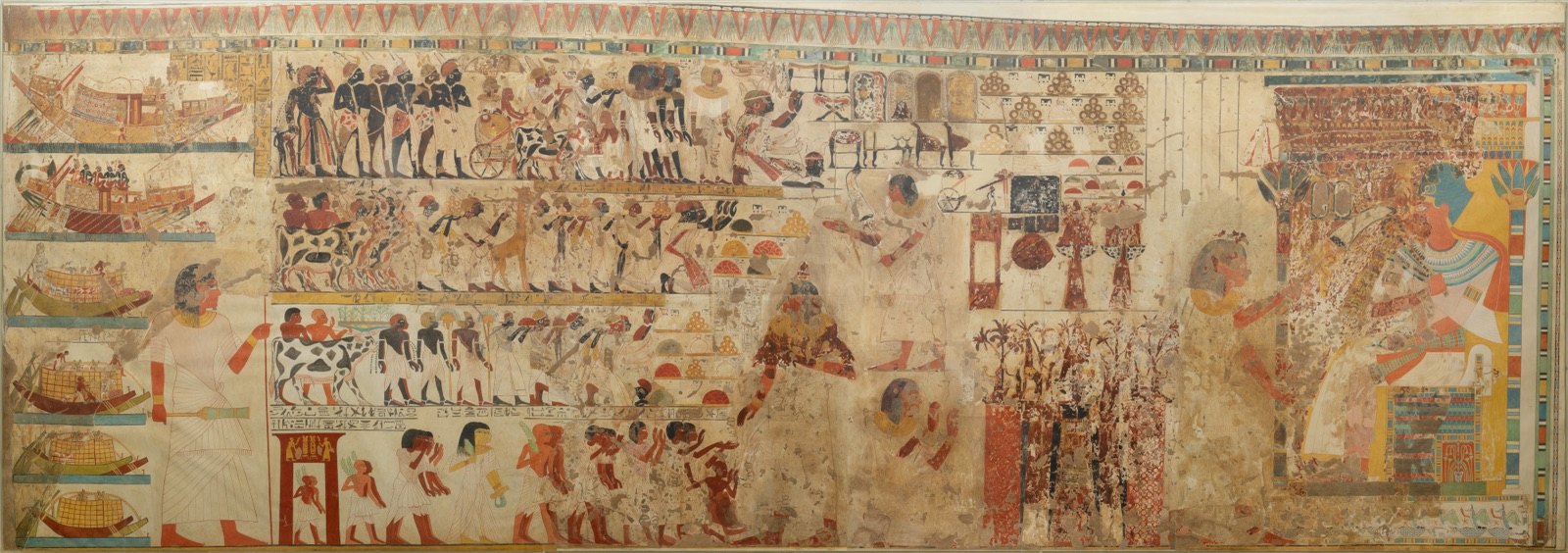
One Nubian in the scene has a name. He is Heqanefer, the chief of Miam, a town in Lower Nubia. Heqanefer also built his own tomb in Nubia. There he had himself shown as an Egyptian official. In Huy’s tomb, he appears in full Nubian dress. The same man appears two ways, depending on who made the picture.
Golden Chains, According to Herodotus
The Greek historian Herodotus, writing in the 400s BCE, told a story about the Persian king Cambyses. After conquering Egypt in the 520s BCE, Cambyses planned to attack the people Herodotus called the long-lived Ethiopians. Greek writers used the name Ethiopians for the peoples south of Egypt. Historians generally read this campaign as aimed at Kush.
According to Herodotus, Cambyses first sent spies with gifts for the Ethiopian king. The king showed them a prison where “all the men were bound with fetters of gold.” Among these people, Herodotus wrote, “there is nothing so scarce and so precious as bronze.”
Treat this one as a legend. Herodotus never visited the place, and he places these people vaguely, at the edge of the known world. Historians also doubt his account of how Cambyses’ campaign turned out. The story shows something real all the same. By the 400s BCE, the lands south of Egypt had a reputation for gold so common it could be used for chains.
A Kushite Pharaoh’s Gifts to the Gods
Kush’s own kings put their gold to work too. Taharqa ruled both Kush and Egypt as a pharaoh of Egypt’s 25th Dynasty, from about 690 to 664 BCE. At Kawa, in Nubia, he built a temple to the god Amun. Stone slabs called stelae, set up in his name, list his gifts to that temple year by year. The lists include gold objects, along with silver, precious stones, and fine cloth. Read more about his reign in Taharqa.
Statues Wrapped in Gold, Then Smashed
In January 2003, archaeologists led by the Swiss archaeologist Charles Bonnet made a remarkable find at Dukki Gel, near the ancient city of Kerma. Buried in a pit were seven huge stone statues of five Kushite kings: Taharqa, Tanutamani, Senkamanisken, Anlamani, and Aspelta.
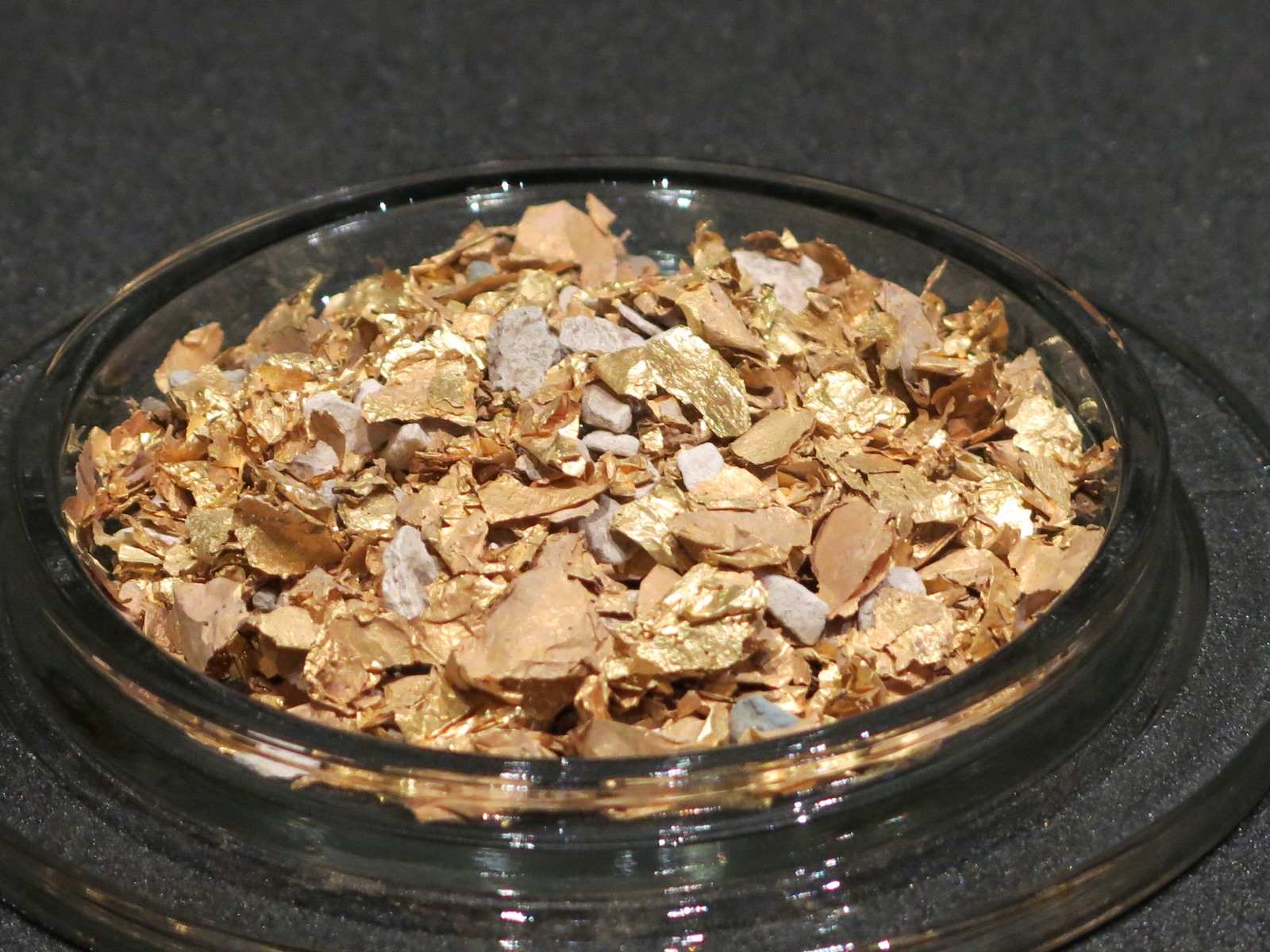
The statues had once shone. The mission found that their stone surfaces had been roughened on purpose. That helped paint stick, along with cloth covered in a thin layer of gold leaf on plaster. Flakes of that gold leaf survived in the ground, and the photo at the top of this article shows some of them.
Someone had broken the statues on purpose. The excavators think this most likely happened during a raid on Nubia by the Egyptian pharaoh Psamtik II, shortly before 590 BCE. Breaking a king’s statue was a way to attack his power. The pieces were then carefully buried. Today the statues stand in the Kerma Museum in Sudan.
A Treasure Hunter Finds a Queen’s Gold
In 1834, the Italian treasure hunter Giuseppe Ferlini tore the tops off pyramids at Meroë, looking for gold. He found it in the pyramid of Queen Amanishakheto: rings, bracelets, and amulets. Many European scholars at first refused to believe Kushite craftsmen made the jewelry. Later study proved it was authentic Kushite work. It now sits in museums in Berlin and Munich. The full story, and the damage Ferlini left behind, is in Why Sudan Has More Pyramids Than Egypt.
Gold Brought Armies Too
Gold made Nubia rich, and it also made Nubia a target. Egypt fought for control of the Nubian gold regions again and again across its history. In 274 BCE, Ptolemy II of Egypt sent an army into Lower Nubia. Historians link that campaign to the gold mines of Wadi Allaqi and Wadi Gabgaba.
Long before that, the first great Kushite kingdom at Kerma buried its rulers with beds covered in gold. Egyptian armies brought the Kerma kingdom to an end around 1500 BCE. Egypt then ruled Nubia, and its gold country, for about four centuries.
Does “Nubia” Mean Land of Gold?
You will often read that the name Nubia comes from nbw, the ancient Egyptian word for gold. It makes a neat story, but the evidence for it is weak. No ancient Egyptian text uses that word as a name for the region. Egyptians called the land Ta-Seti, Wawat, or Kush. Many scholars trace the name Nubia to the Noba, a people Greek writers later named in the area.
Was There a Kushite Mansa Musa?
The most famous gold story in African history belongs to Mansa Musa, emperor of Mali. In 1324 CE, he passed through Cairo on his pilgrimage to Mecca and gave away so much gold that, according to the writer al-Umari, its value in Cairo dropped for years afterward. Some historians now question even that story. One argues the drop in price was within normal swings for Cairo at the time.
No surviving record tells a story like that about a king of Kush. Kush’s gold stories are of a different kind: foreign kings begging for gold, gilded statues smashed by enemies, and a queen’s jewelry pulled from her pyramid. All of them are documented, and every one of them is true.
Frequently Asked Questions
Was ancient Kush rich in gold?
Yes. The deserts on either side of the Nile in Nubia held gold, and people mined it there for thousands of years. Egypt worked hard to control those mines. Kushite kings and queens were buried with gold jewelry, and gold leaf once covered parts of their statues.
Where did Kush's gold come from?
It came from gold deposits in the deserts of Nubia, in what is now southern Egypt and northern Sudan. The richest known areas lay in the desert east of the Nile, including Wadi Allaqi and Wadi Gabgaba.
Does the name Nubia mean land of gold?
Probably not. A popular theory links Nubia to nbw, the ancient Egyptian word for gold. Scholars point out that no ancient Egyptian text uses that word as a name for the region. Many trace the name instead to the Noba, a people Greek writers named in the area.
Did a king of Kush ever crash the price of gold, like Mansa Musa?
No record of that survives. The Mansa Musa story comes from Mali in 1324 CE, nearly a thousand years after Kush ended. Even that story is debated. One historian argues the drop in Cairo's gold price was within normal swings for the time.
Sources
- Gold and Gold Mining in Ancient Egypt and Nubia — Rosemarie and Dietrich Klemm, Springer, 2013
- Amarna letters — Wikipedia, citing William L. Moran, The Amarna Letters, 1992
- Amarna letter EA 7 — Wikipedia, with A. Leo Oppenheim's translation
- Nubian Tribute Presented to the King, Tomb of Huy — The Metropolitan Museum of Art
- TT40, the tomb of Huy, Viceroy of Kush — Wikipedia
- Herodotus, Histories, Book 3 — LacusCurtius, University of Chicago
- Doukki Gel — Swiss-French-Sudanese Archaeological Mission at Kerma
- Taharqa's Kawa stelae — Thesaurus Linguae Aegyptiae
- Nubians — Wikipedia
- Mansa Musa — Wikipedia
Cite This Work
- APA
- Kush History. (2026). The Gold of Kush: True Stories From Nubia's Treasure. Retrieved October 25, 2026, from https://kushhistory.com/the-gold-of-kush/
- Chicago
- Kush History. "The Gold of Kush: True Stories From Nubia's Treasure." Published October 20, 2026. https://kushhistory.com/the-gold-of-kush/.
- MLA
- Kush History. "The Gold of Kush: True Stories From Nubia's Treasure." Oct 20, 2026, https://kushhistory.com/the-gold-of-kush/.
Researched and written by Sunni. About this site.