 Kush
Kush 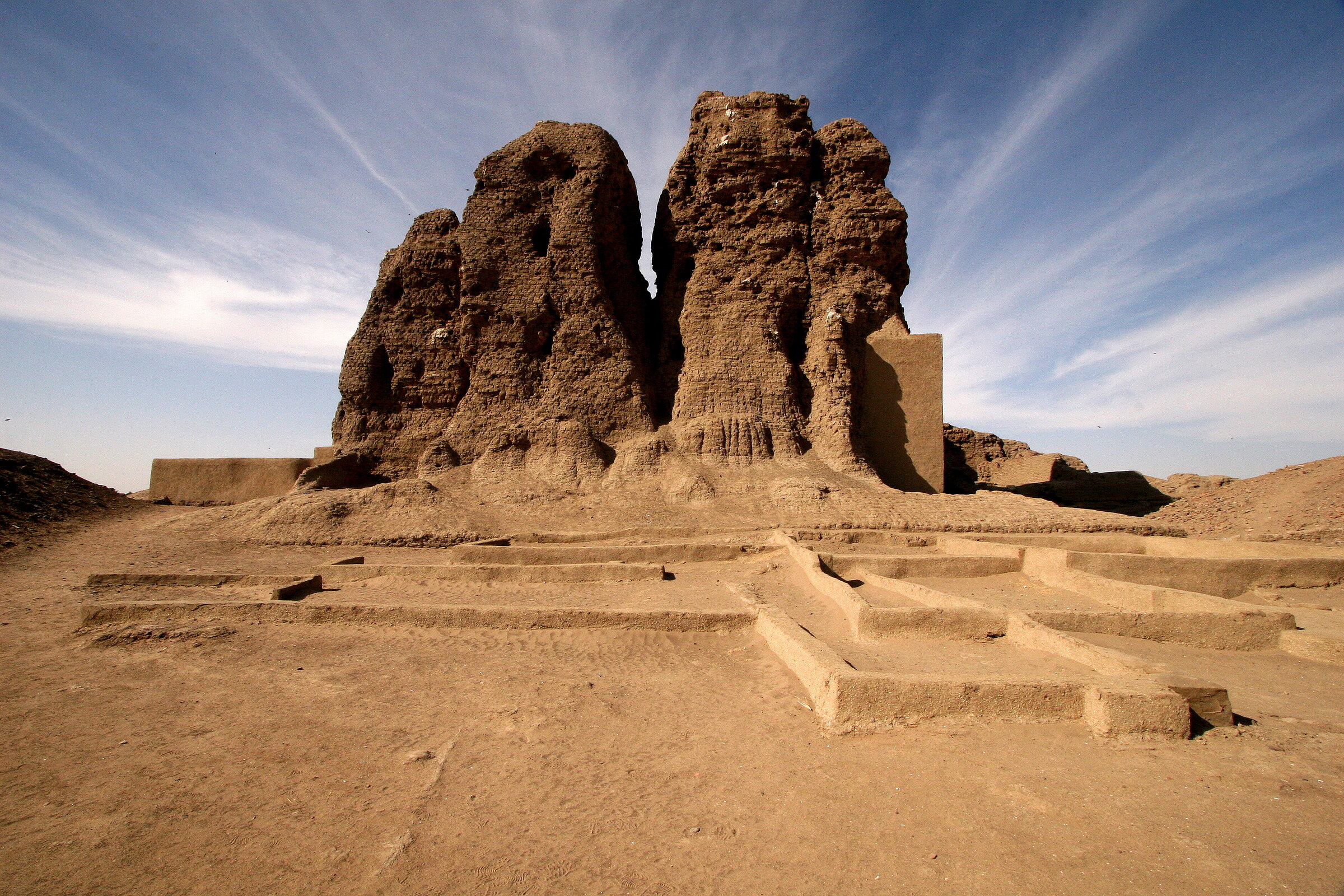
Photo: Walter Callens, CC BY 2.0, via Wikimedia Commons
Kerma: The First Great Kingdom of Kush
Kerma, pronounced KER-muh, was the first great kingdom to rise along the Nile in what is now Sudan. It flourished from about 2500 to 1500 BCE, roughly seven centuries before the Kushite kings of Napata, and Egyptian texts already called its ruler the ruler of Kush.
A City on the Nile
Kerma grew up near the Nile’s third cataract, in northern Sudan. The Nile has six of them between Egypt and Khartoum, numbered from north to south. Archaeologists divide its long history into three periods. Early Kerma runs from about 2500 to 2000 BCE. Middle Kerma runs from about 2000 to 1750 BCE. Classic Kerma, the kingdom’s peak, runs from about 1750 to 1500 BCE.
By 1700 BCE the city held at least 10,000 people. At its height the kingdom controlled the Nile from the first cataract to the fourth, and its reach ran north to the border of Egypt. The river that fed Kerma also fed the later kingdom of Kush, as the story of why the Nile made Kush a superpower explains.
The Mud-Brick Tower
The center of Kerma was a huge temple. Its name is the Deffufa, a word from the Nubian language for a mud-brick building.
The Western Deffufa measures about 172 feet by 88 feet, or 52 meters by 27 meters. It stands about 65 feet, or 20 meters, high, and writers often describe it as a five-story tower. Its builders made it entirely from sun-dried mud brick after 1750 BCE.
Inside, the Deffufa had chambers, courtyards, an interior staircase to a rooftop platform, and underground rooms. Historians think it was the city’s main temple. The god it honored is unknown, and so are the details of its ceremonies.
The Eastern Deffufa had a clearer job. It was a funeral chapel beside the royal cemetery, some distance from the city, where the dead kings were honored.
Kings and Their Tombs
Kerma’s cemetery holds about 30,000 burials, one of the largest cemeteries found from the ancient world. The greatest kings lay under huge circular mounds called tumuli. Sources give the widest mounds a diameter between about 200 and 295 feet, or 60 and 90 meters. Two of them were covered in white quartzite cones.
The tombs held rich goods. Excavators found beds covered in gold and inlaid with ivory, copper daggers in beaded belts, and polished red pottery with black tops.
The largest tombs also held many people. Between 50 and several hundred were laid in a corridor leading to the king’s burial chamber. A study of their skeletons found no signs of violence. Its authors think they were local attendants who followed their king in death. Whether they went willingly is unknown.
Egypt’s Neighbor to the South
Egypt knew the region well. By the Old Kingdom, Egyptians called it Ta-Seti, the Land of the Bow. Kerma and Egypt traded gold, ivory, exotic animals, and two goods worth explaining. Ebony is a very hard, dark wood prized for furniture and carving. Incense is a resin that gives off a sweet smoke when burned, used in temples and ceremonies. Egypt also built forts along the border to guard against raids from the south.
The rivalry peaked around 1550 BCE, when Egypt was split in two. A stela, a carved stone slab, tells the story. Three rulers play a part in it:
- Kamose ruled southern Egypt and wanted to drive out the Hyksos.
- Apepi was the king of the Hyksos, a foreign dynasty that ruled northern Egypt.
- The ruler of Kush was the king of Kerma, as historians read the text.
Kamose’s soldiers caught a messenger carrying a letter from Apepi to the ruler of Kush. The letter asked Kerma’s king for urgent help against Kamose. In answer, Kamose sent troops to seize the Bahariya Oasis, a watered stop in the western desert that controlled a north to south route.
How Kerma Ended
Egypt then turned south. Around 1500 BCE, King Thutmose I led an army up the Nile and built a fortress at Tombos, near the third cataract. A soldier named Ahmose, son of Ebana, wrote in his tomb that the king fought in the battle and killed the Nubian king himself.
Historians usually date the end of the Kerma kingdom to about 1500 BCE. Thutmose III completed Egypt’s conquest around 1450 BCE. Egypt then ruled Nubia for about four centuries, until its own empire there collapsed around 1070 BCE. One of the sites Egypt built in this era rose at Jebel Barkal, the mountain that later anchored Napata.
Who Built It?
The first archaeologist to dig at Kerma was George Reisner, whose Harvard and Boston team worked there from 1913 to 1916. Reisner believed Kerma was an Egyptian outpost. An outpost is a town or fort that a country builds far from home to control land and trade. Reisner thought the Deffufa was the palace of an Egyptian governor.
His idea had real reasons behind it.
- Egyptian objects lay in Kerma’s tombs, including statues and carved stones. Reisner read them as signs of Egyptian rule.
- Reisner trained as an Egyptologist. He read the tombs through what he knew of Egyptian burial customs.
- Egypt did build outposts in Nubia. The fortress at Tombos is one example, built during Egypt’s conquest of Kerma.
- Egyptian texts were the main written record, and they said little about Kush’s own culture.
- Scholars of his time often assumed that great buildings in Africa south of Egypt needed an Egyptian teacher. Reisner’s own writing followed that assumption. Modern scholars call it a bias of his era.
The Egyptian objects have another possible explanation. An Egyptian governor named Sobeknakht wrote in his tomb that Kushite raiders reached the Egyptian town of Elkab around 1550 BCE and carried loot home. Some historians think Kerma’s Egyptian statues came from raids like that. They may have been trophies.
Reisner’s idea held for decades, although some scholars questioned it early. Then the Swiss archaeologist Charles Bonnet began digging at Kerma in the 1970s and led his team there until 2003. His finds included tombs, buildings, and pottery older than the Egyptian conquest of about 1500 BCE. The Deffufa itself dates to after 1750 BCE, which makes it older than that conquest too. Egyptian governors could not have built it.
Bonnet called Kerma a kingdom completely free of Egypt, with its own building and burial customs. Researchers still use the skeletons and records that Reisner’s team collected.
Kerma and the Origin of Kush
Egyptian texts from around 1550 BCE call the ruler of Kerma the ruler of Kush. Historians think the later Kingdom of Kush probably grew out of Kerma culture, with heavy Egyptian influence added. How direct that link was is hard to say. The language Kerma’s people spoke is also unknown. Most of what historians know comes from archaeology and from Egyptian texts.
One find hints at a memory of Kerma. In 2003 Bonnet’s team uncovered a cache of granite statues of Kushite kings at Dukki Gel, near Kerma. The kings include Taharqa and Anlamani, who lived about 800 years after Kerma ended. Archaeologists read the cache as a sign that Kushite kings still honored the old site. Read more about Taharqa, and about the crown symbol on the statues in the uraeus.
Visiting Today
The Western Deffufa still stands above the ruins of the ancient city, and the Kerma Museum nearby displays finds from the site, including the statues. As with anywhere in Sudan right now, check current travel advisories before making any plans.
Kerma’s kings lay under mounds. Kush’s later kings lay under pyramids. Read about those in Why Sudan Has More Pyramids Than Egypt, and about the centuries when Kush ruled Egypt in The Black Pharaohs.
Sources
- Kerma culture — Wikipedia
- Kerma — Wikipedia
- Western Deffufa — Wikipedia
- Kerma — World History Encyclopedia
- Kerma Kingdom Rules Nubia — EBSCO Research Starters
- A Nubian Kingdom Rises — Archaeology Magazine, September/October 2020
- Dying to Serve: The Mass Burials at Kerma — Judd and Irish, Antiquity, 2009
- Research — Kerma, Swiss Archaeological Mission
- Kerma and the Deffufa — Cultural Heritage Online
- Kamose — Wikipedia
- Thutmose I — Wikipedia
Cite This Work
- APA
- Kush History. (2026). Kerma: The First Great Kingdom of Kush. Retrieved September 28, 2026, from https://kushhistory.com/places/kerma/
- Chicago
- Kush History. "Kerma: The First Great Kingdom of Kush." Published September 27, 2026. https://kushhistory.com/places/kerma/.
- MLA
- Kush History. "Kerma: The First Great Kingdom of Kush." Sep 27, 2026, https://kushhistory.com/places/kerma/.
Researched and written by Sunni. About this site.