 Kush
Kush vs. Aksum: Two African Kingdoms and the End of Meroë
Kush and Aksum were two different African kingdoms. Kush ruled the Nile Valley in what is now Sudan for well over a thousand years, until around 350 CE. Aksum rose in the highlands of what are now Eritrea and northern Ethiopia in the first century CE and lasted until around 960 CE.
Aksum has a long, rich history of its own, separate from Kush’s. The two stories cross at one moment. In the 300s CE, as Kush was coming to its end, Aksumite armies marched into Kush’s lands.
At a Glance
Homeland
Kush
The Nile Valley, in what is now Sudan
Aksum
The highlands of what are now Eritrea and northern Ethiopia
Years
Kush
About 1000 BCE to 350 CE
Aksum
About the 1st century CE to 960 CE
Capital
Kush
Napata, then Meroë
Aksum
Aksum
Main trade route
Kush
The Nile River
Aksum
The Red Sea, through the port of Adulis
Writing
Kush
Egyptian hieroglyphs, then Kush's own Meroitic script
Aksum
Ge'ez, plus Greek and Sabaic on royal inscriptions
Religion
Kush
Amun, Apedemak, and other gods
Aksum
Older gods, then Christianity from the 300s CE
Royal monuments
Kush
Steep stone pyramids
Aksum
Tall carved stone stelae
A River Kingdom and a Sea Kingdom
Kush grew rich along the Nile. Its later capital, Meroë, sat on the river’s east bank, and goods moved north through Kush toward Egypt and the Mediterranean.
Aksum grew rich along the Red Sea. Its capital sat in the highlands, and its port at Adulis linked it to trade across the Red Sea. A Greek trading guide called the Periplus of the Erythraean Sea, written around the middle of the first century CE, is the first known record to mention Aksum.
By the 200s CE, Aksum had become a major power. The Persian religious teacher Mani counted it as one of the four great kingdoms of his world, alongside Rome, Persia, and China. Aksum began minting its own gold, silver, and bronze coins in the late 200s CE.
Different Ways to Honor Kings
Kush buried its rulers under steep stone pyramids, close to 255 of them in all.
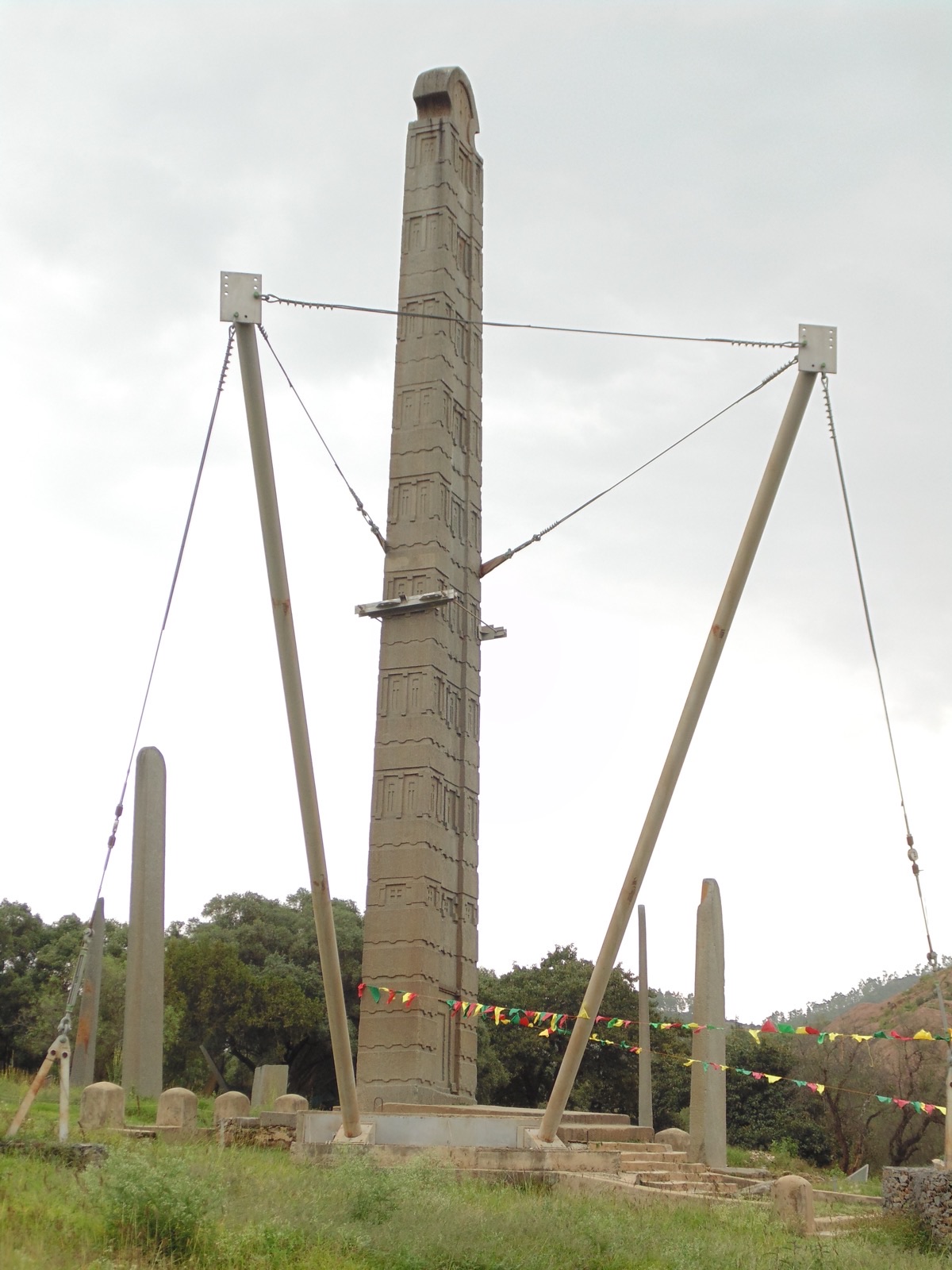
Aksum marked its royal tombs with . The grandest were carved to look like towering buildings, with false doors and windows stacked one above another. The largest would have stood about 33 meters tall, but it broke.
Both kingdoms wrote their own languages too. Kush created the Meroitic script. Aksum wrote in Ge’ez, a script that grew out of older South Arabian writing. Adapted forms of it still write languages of Ethiopia and Eritrea today.
Aksum Arrives at Meroë
By the 300s CE, Kush was under pressure on several sides. A people called the Noba had moved into its heartland along the Nile. Roman Egypt to the north was in its own long crisis, and the trade that had made Kush rich was shrinking.
Aksum’s armies reached Meroë itself. Archaeologists there have found two broken Greek inscriptions left by Aksumites. The better preserved one mentions military action and a tribute imposed on the conquered. These were probably set up before about 340 CE, possibly under an Aksumite king named Ousanas.
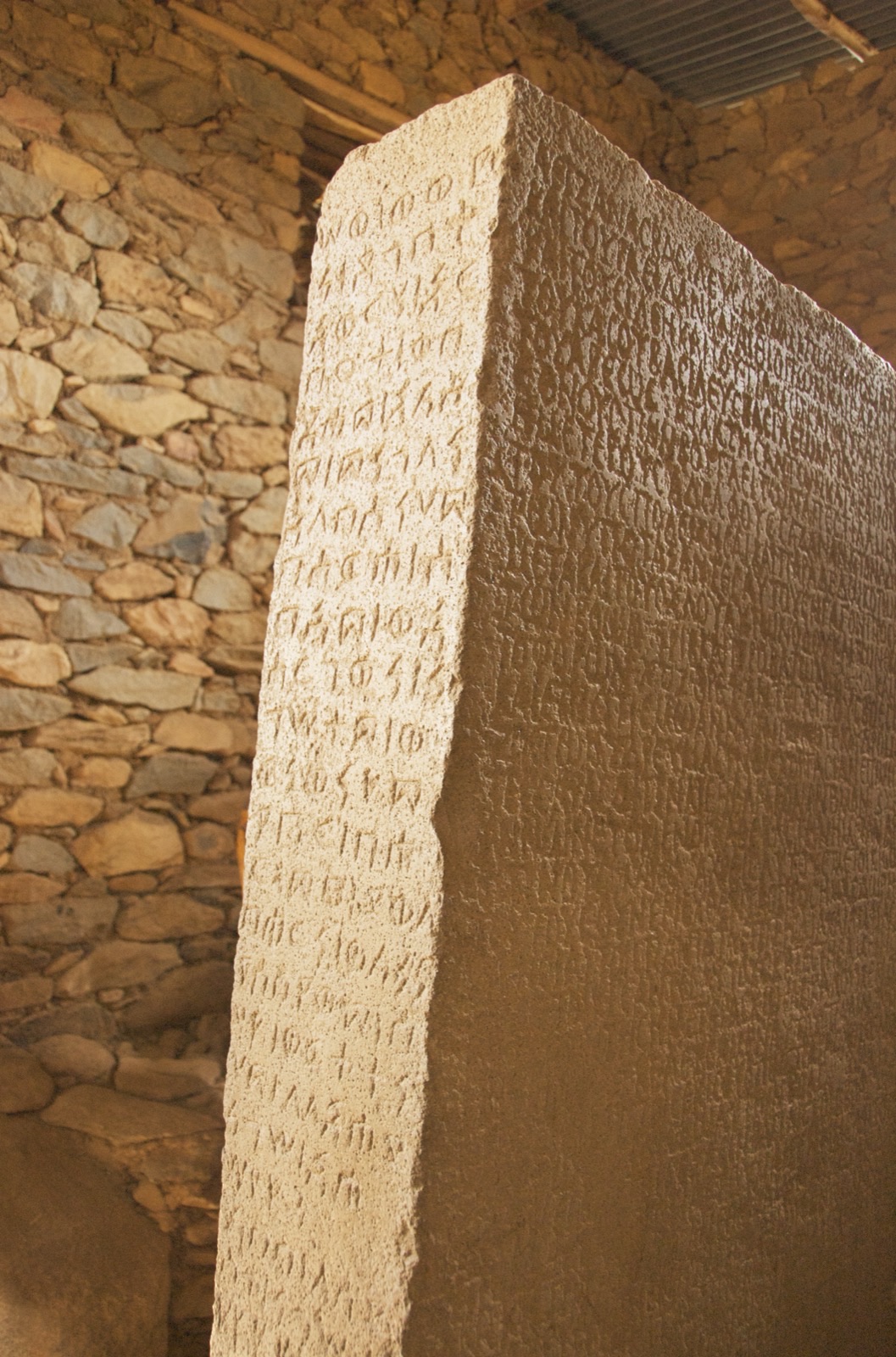
A later king, Ezana, left longer records. His inscriptions describe a campaign around 350 CE after the Noba “revolted and boasted.” His army burned villages with walls of stone and villages with walls of straw. It fought a people the inscription calls the Kasu, where two rivers meet. Many historians read Kasu as a name for the people of Kush. Meroë itself is never named in Ezana’s account.
Did Aksum Destroy Kush?
Historians still debate this. Some treat Aksum’s campaigns as the blow that ended Kush. Others argue Kush was already falling apart from the inside.
Several causes come up again and again in the research:
- Aksum’s military campaigns in the 300s CE
- The Noba moving into Kush’s heartland
- Trade along the Nile drying up as Rome’s own troubles grew
- Political and economic instability inside Kush
- Strain on the land, possibly including heavy tree cutting to fuel iron working
Aksum’s hold on Meroë seems to have been brief. The last pyramids and burials at Meroë date to the middle of the 300s CE. That is the point historians usually mark as the end of the Kingdom of Kush.
What Came After
Aksum outlasted Kush by about six hundred years. Ezana became the first king of Aksum to adopt Christianity, in the 300s CE. Aksum began to decline in the 600s CE and collapsed around 960 CE.
The Nile Valley that Kush once ruled did not sit empty. New kingdoms rose there, called Nobadia, Makuria, and Alodia. All three adopted Christianity in the 500s CE. People kept living, farming, and building along that same stretch of river, as they had under Kush for more than a thousand years. Read where that river kingdom began in Why the Nile Made Kush a Superpower.
Frequently Asked Questions
Did Aksum destroy the Kingdom of Kush?
Aksum played a part, but historians still debate how big a part. Aksumite armies campaigned in Kush's territory in the 300s CE, and Aksumite inscriptions have been found at Meroë. Kush was also under pressure from the Noba people, falling trade, and other troubles. Historians weigh Aksum's role alongside those other causes.
Were Kush and Aksum the same kingdom?
They were two separate kingdoms. Kush ruled the Nile Valley in what is now Sudan, with its capital at Meroë in its later centuries. Aksum ruled the highlands of what are now Eritrea and northern Ethiopia, with its capital at the city of Aksum.
Where was the Kingdom of Aksum?
Aksum was based in what are now Eritrea and northern Ethiopia, southeast of Kush. Its capital was the city of Aksum, and its main port was Adulis on the Red Sea. At its height, its reach extended into parts of Sudan, Yemen, and Saudi Arabia.
Who was King Ezana of Aksum?
Ezana ruled Aksum in the 300s CE. He was the first king of Aksum to adopt Christianity. His inscriptions describe a campaign around 350 CE against the Noba and a people called the Kasu, in lands that had belonged to Kush.
Cite This Work
- APA
- Kush History. (2026). Kush vs. Aksum: Two African Kingdoms and the End of Meroë. Retrieved October 25, 2026, from https://kushhistory.com/kush-vs-aksum/
- Chicago
- Kush History. "Kush vs. Aksum: Two African Kingdoms and the End of Meroë." Published October 19, 2026. https://kushhistory.com/kush-vs-aksum/.
- MLA
- Kush History. "Kush vs. Aksum: Two African Kingdoms and the End of Meroë." Oct 19, 2026, https://kushhistory.com/kush-vs-aksum/.
Researched and written by Sunni. About this site.